Explore
Featured
Recent
Articles
Topics
Login
Upload
Featured
Recent
Articles
Topics
Login
Upload
Search Results for 'Multicellular-Unicellular'
Multicellular-Unicellular published presentations and documents on DocSlides.
Unicellular and Multicellular Organisms
by briana-ranney
LESSON 3. Unicellular Organisms. Organisms that c...
Unicellular vs. Multicellular Organisms
by mitsue-stanley
Creating a T Chart of Benefits and Limitations. S...
Unicellular Organisms Unicellular Organisms
by jane-oiler
Made of only one cell!!. With a partner...brainst...
Unicellular vs.
by lindy-dunigan
Multicellular. Which is better?. Questions to Con...
Pond Water . Pond Water seen under a microscope.
by jaena
Your Objective. 1. You will understand that . org...
Types of Organisms
by sherrill-nordquist
Unicellular Organisms. vs.. Multicellular Organis...
Free powerpoints at
by cheryl-pisano
http://www.worldofteaching.com. A . view. of . t...
WALT: Describe what unicellular living things are
by elysha
WILF: . To know how unicellular living things are...
Happy Tuesday Bell Work Monday: Test analysis
by joanne
Tuesday: Finish Test Analysis. Today:. List . the ...
The 5 Six Kingdoms Mrs. Feorino
by olivia-moreira
7. th. Grade Science. P.S. DuPont Middle School....
The Six Kingdoms
by mitsue-stanley
The History of Classification. In the 1700’s, L...
6 Kingdoms of Life
by cheryl-pisano
As living things are constantly being investigate...
Taxonomy - Chap 14 and 19
by stefany-barnette
Taxonomy is the science of naming and classifying...
Sec 1. Cells of Multicellular Organisms p104
by mila-milly
Multicellular. organisms, or organisms that are ...
Kingdom Protista Protists- the
by trish-goza
hodge. - podge group. Basics. Eukaryotic. 3 group...
EQ: How can organisms be classified as single-celled or mul
by stefany-barnette
Turn and Talk. What is a cell?. What is an organi...
How do we classify living organisms?
by pamella-moone
The Diversity of Life. Taxonomy . is the study an...
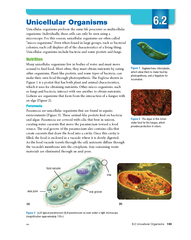
6.2 Unicellular Organisms 143
by olivia-moreira
Unicellular organisms perform the same life proces...
Introduction to
by natalie
Fungi Classification, Morphology and Pathogenici...
Classification I can classify living organisms?
by QueenBee
Standards. GSE S7L1: Obtain, evaluate, and communi...
Characteristics of Life Watch the video, read through the PowerPoint, and answer the questions at t
by paige
How do living things differ from . non-living thin...
Kingdom Protista ( Protists
by karlyn-bohler
). Protists. are….. organisms that cannot be c...
Biology: Science of Life
by alexa-scheidler
Biology: Science of Life What do Biologists do? ...
Chapter 7 Notes
by stefany-barnette
Protists. and Fungi. 2. 7. -1 Notes: . Protists....
Kingdoms and Domains 18.3
by celsa-spraggs
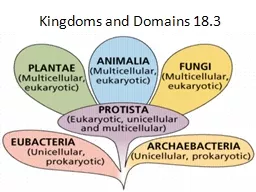
Domain. Most inclusive taxonomic category; larger...
Kingdoms Organizer
by pamella-moone
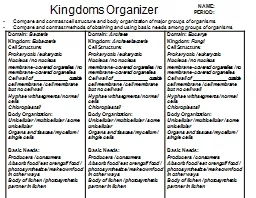
Compare and contrast cell structure and body orga...
Plant-Like
by calandra-battersby
Protists. (Algae). Autotrophs. – . photosynth...
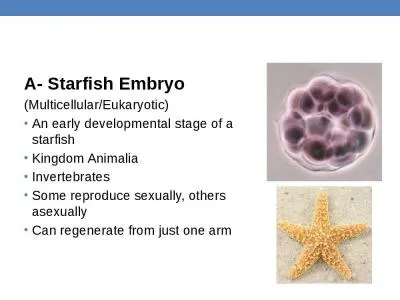
A- Starfish Embryo (Multicellular/Eukaryotic)
by jainy
An early developmental stage of a starfish. Kingdo...
DESCRIBE SEAWEED
by phoebe-click
How does seaweed benefit life in the ocean? Human...
Robust
by stefany-barnette
multicellular. computing using genetically encod...
Kingdom Protista
by tatyana-admore
Animal like, plant like and fungi like. Objective...
Understanding Classification
by lindy-dunigan
Classification of Living Things. There are 13 bil...
Chapter 8 Protists and
by eve
FUNGi. Lesson 1. What are . Protists. ?. Protists....
Thursday May 18, 2017 Agenda
by sadie
(10) Catalyst. (. 10) GN: Unicellular Adaptations....
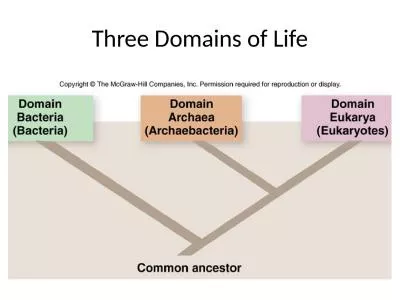
Three Domains of Life The Microbial World
by tracy
All three biological domains include microbial org...
TAXONOMY Taxonomy Taxonomy:
by catherine
The discipline of classifying organisms and assign...
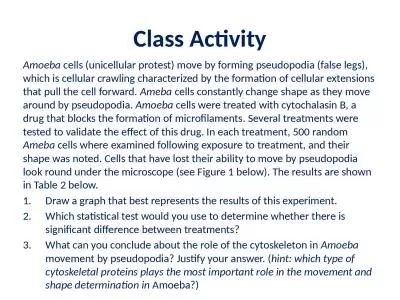
Class Activity Amoeba cells (unicellular protest) move by forming pseudopodia (false legs), which
by holly
pull the cell forward. . Ameba. cells constantly ...
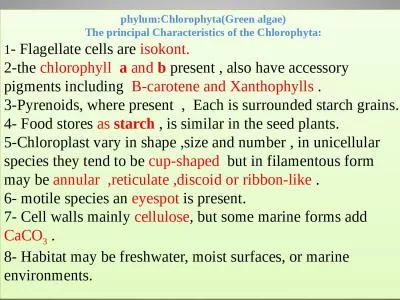
phylum:Chlorophyta (Green
by lucinda
algae). The principal Characteristics of the . Chl...
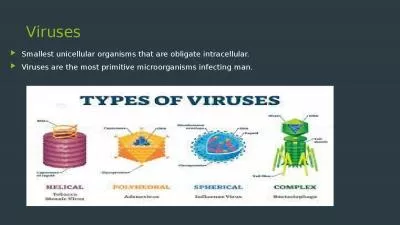
Viruses Smallest unicellular organisms that are obligate intracellular.
by genevieve
Viruses are the most primitive microorganisms infe...
Year 8 Lesson 9 – cells
by eve
Science. Learning intention. To understand the dif...
Load More...